
Turning Diaspora Expertise Into Local Innovation, Manufacturing And Jobs
The Diaspora Technology Transfer Readiness Index (DTRI) is a Phase 1 initiative of the Diaspora Country Index (DCI). DTRI assesses whether countries have the systems needed to connect diaspora expertise with local research institutions, businesses and public agencies. Its focus is practical transfer: adapting knowledge and technology, putting both to work, and retaining the resulting skills, tacit knowledge, and capabilities locally.
Why technology transfer matters
Technology transfer helps firms improve production methods, helps researchers solve industry problems, and helps new ideas reach the market. Joint R&D, licensing, product development and supplier partnerships create paths from research to commercial use. Stronger local capabilities support innovation, manufacturing growth and skilled jobs. Export readiness also depends on firms meeting quality standards, building reliable supply chains and competing in international markets. The OECD’s review of science-industry links and the World Bank’s analysis of Viet Nam’s value chains describe these connections.
Technology adoption has helped countries advance from low-income production toward more sophisticated industries and export markets. South Korean firms licensed foreign technology, developed engineering skills and expanded manufacturing. Chile adapted aquaculture technology from abroad and became a major salmon exporter. Investment, education, industrial policy and market access also shaped these outcomes. The World Bank’s 2024 development report places technology adoption at the center of the move toward middle-income growth, while its country examples show how countries turned external knowledge into domestic capability.
Why the diaspora matters
Diaspora researchers, engineers, founders and industry professionals connect local partners with international knowledge, equipment, production practices and markets. They contribute through joint research, technical training, licensing, product development, startup support and manufacturer partnerships. DTRI asks whether a country has clear priorities and working pathways for these contributions to reach local institutions and firms.
What DTRI measures
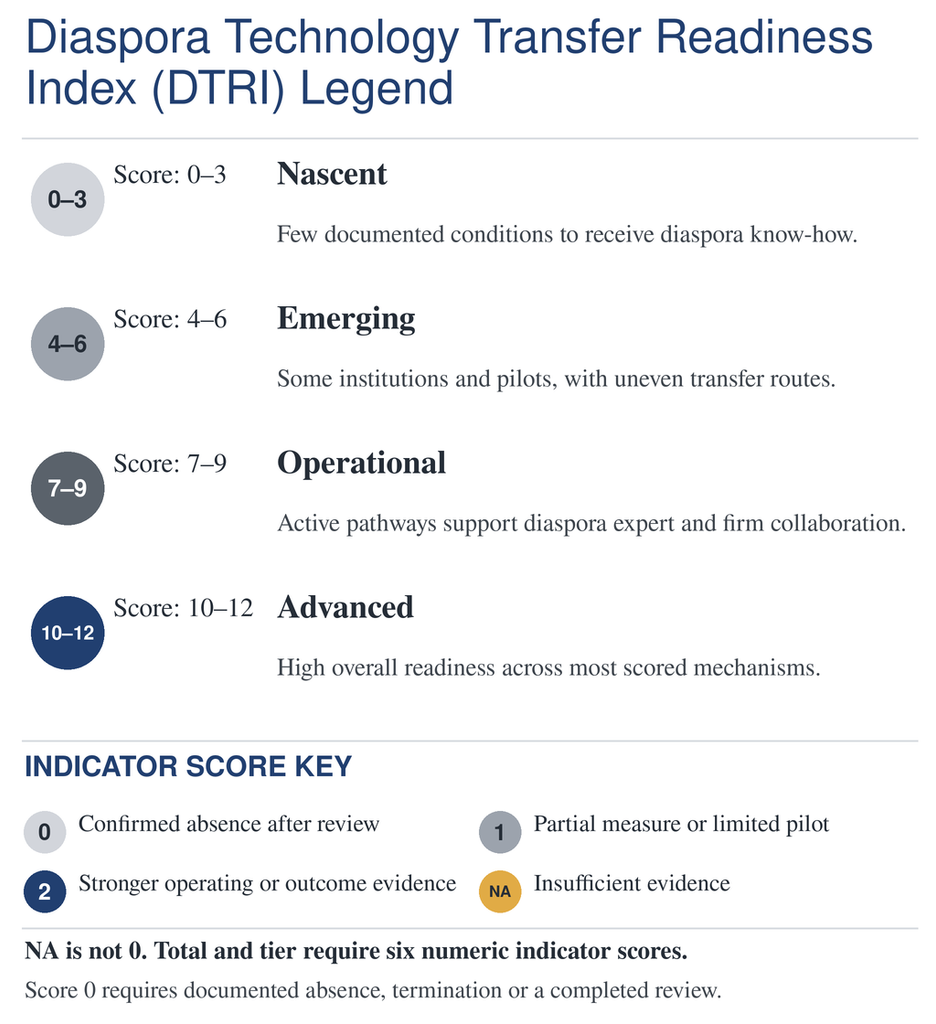
DTRI uses six equally weighted indicators. Each receives a score from 0 to 2, for a possible total of 12.
1. National Strategy and Accountable Ownership. Clear priorities for diaspora technology transfer and an institution responsible for delivery.
2. Diaspora Technology Talent Intelligence and Networks. Ways to identify and connect relevant diaspora expertise with local needs.
3. Domestic Demand and Absorptive Capacity. Local firms, universities and research institutions with defined problems and the capacity to adopt new knowledge.
4. Matching, Mobility and Collaboration Pathways. Working routes for diaspora experts and local partners to undertake joint R&D, technical assignments and other collaborations.
5. Deployment Finance, Intellectual Property and Commercialization Support. Support for funding, intellectual property, licensing, startups and the path from prototype to market.
6. Verified Delivery and Local Retention. Documented transfer activity and evidence of skills or capabilities retained by local partners.
How to read the results
DTRI measures readiness for diaspora-enabled technology transfer. Its scores do not measure R&D spending, products commercialized, manufacturing jobs, export performance or a country’s future income growth. The 15 pilot countries form a selected sample, not a ranking of Africa’s top 15 countries.
August scores are provisional desk assessments pending a second review and country-level validation. An NA entry means insufficient evidence, not a score of zero.
August 2026 Diaspora Technology Transfer Readiness Index (DTRI)
| Rank | Country | African Union Region | National Strategy and Accountable Ownership (0–2) | Diaspora Technology Talent Intelligence and Networks (0–2) | Domestic Demand and Absorptive Capacity (0–2) | Matching, Mobility and Collaboration Pathways (0–2) | Deployment Finance, Intellectual Property and Commercialization Support (0–2) | Verified Delivery and Local Retention (0–2) | Total Readiness Score (0–12) | Readiness Tier | Evidence Coverage (of 6 Indicators) |
|---|---|---|---|---|---|---|---|---|---|---|---|
| 1 | Kenya | Eastern | 2 | 2 | 2 | 2 | 1 | 1 | 10 | Advanced | 6/6 |
| 1 | Mauritius | Eastern | 2 | 1 | 2 | 2 | 2 | 1 | 10 | Advanced | 6/6 |
| 1 | Morocco | Northern | 2 | 2 | 2 | 2 | 1 | 1 | 10 | Advanced | 6/6 |
| 4 | Ethiopia | Eastern | 2 | 1 | 2 | 2 | 1 | 1 | 9 | Operational | 6/6 |
| 4 | Nigeria | Western | 2 | 1 | 2 | 2 | 1 | 1 | 9 | Operational | 6/6 |
| 4 | Rwanda | Eastern | 2 | 1 | 2 | 2 | 1 | 1 | 9 | Operational | 6/6 |
| 4 | Senegal | Western | 2 | 1 | 1 | 2 | 2 | 1 | 9 | Operational | 6/6 |
| 8 | Cabo Verde | Western | 2 | 2 | 1 | 1 | 1 | 1 | 8 | Operational | 6/6 |
| 8 | Tunisia | Northern | 2 | 1 | 1 | 1 | 2 | 1 | 8 | Operational | 6/6 |
| 10 | Cameroon | Central | 1 | 1 | 1 | 1 | 1 | 1 | 6 | Emerging | 6/6 |
| Egypt | Northern | 1 | 1 | 2 | 1 | 2 | NA | 5/6 | |||
| Zambia | Southern | 2 | 1 | 2 | 1 | 2 | NA | 5/6 | |||
| Ghana | Western | 1 | NA | 1 | 1 | 1 | NA | 4/6 | |||
| South Africa | Southern | 1 | NA | 2 | 1 | 2 | NA | 4/6 | |||
| Democratic Republic of the Congo | Central | 1 | NA | NA | NA | NA | NA | 1/6 |
| 15 selected pilot countries cover all five AU regions. This is not a continent-wide top 15; only six-indicator complete countries have a score, tier and rank. Zambia and South Africa represent Southern Africa in the pilot. Both remain unranked due to incomplete indicator evidence, so the August ranking includes countries from four of the five African Union regions. |
| NA means evidence is incomplete, never zero. All rankings are provisional until a second reviewer and country validators confirm the evidence, especially delivery outcomes. |
Disclaimer
DTRI is a provisional research benchmark for 15 selected pilot countries. Scores reflect documented pathways for diaspora technology transfer. They do not establish nationwide performance or direct economic impact. Public documentation differs across countries and may omit active programmes. Equal indicator weights are an analytical choice, not evidence of equal effects on innovation, commercialization, manufacturing, exports or jobs. The results support research and policy discussion. They do not certify export readiness or predict income growth.
Methodology Note
This Phase 1 pilot uses six equally weighted indicators, each scored from 0 to 2, for a possible total of 12. Indicator-specific criteria guide each score. A score of 0 requires authoritative evidence of no active pathway, documented termination or a completed standardized review. Insufficient evidence receives NA, never 0. Only countries with evidence for all six indicators receive a total score, tier and rank.
The readiness tiers are Nascent (0–3), Emerging (4–6), Operational (7–9) and Advanced (10–12). These labels describe scores within the pilot framework.
DCI prepared the August 2026 snapshot retrospectively, with an evidence cutoff of 31 August 2026. The assessment prioritizes official policy, program, budget and delivery records, followed by multilateral implementation records. Unsupported press claims alone do not justify a score of 2. Implementation evidence generally covers the preceding 36 months. Older policies qualify if still in force. The desk assessments remain provisional pending a second review and country validation, especially for delivery outcomes.