
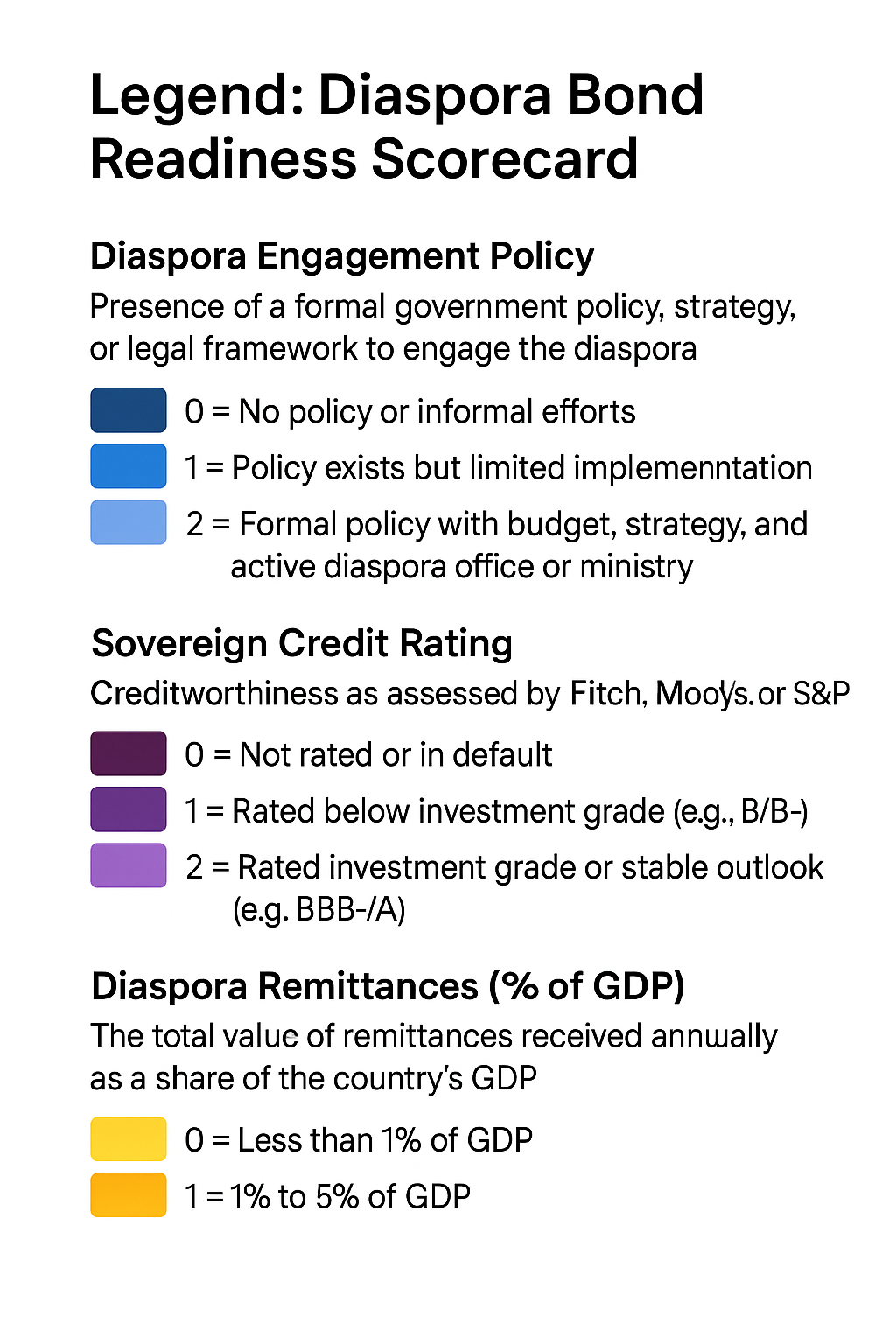
This Readiness Index is based on qualitative research in partnership with our research and academic partners. Our methodology.

Monthly updates of this data will aid emerging economies in determining their readiness for issuing diaspora bond offerings within our focus region of Africa. S&P credit ratings are indicated in RED. The highlighted GREEN text indicates a nation’s readiness.
Amidst a decline in ODA from Western countries, global south countries may need to turn to their overseas diasporas for financial support in sectors like healthcare, agriculture, energy production, infrastructure, and digital transformation. This readiness index can assist a country in evaluating its ability to issue financial instruments, such as bonds to support a country’s economic development.
September Diaspora Bond Readiness Index
| Country | S&P Credit Rating | Outlook | Diaspora Engagement Policy (0-2) | Sovereign Credit Rating (0-2) | Diaspora Remittances (% of GDP) (0-2) | Total Readiness Score (0-6) | Readiness Category |
|---|---|---|---|---|---|---|---|
| Algeria | NR | Not rated | 2 | 0 | 0 | 2 | low |
| Angola | B- | Stable | 0 | 1 | 1 | 2 | low |
| Benin | BB- | Stable | 2 | 1 | 2 | 5 | high |
| Botswana | BBB- | Negative | 2 | 2 | 1 | 5 | high |
| Burkina Faso | CCC+ | Stable | 0 | 1 | 0 | 1 | low |
| Burundi | NR | Not rated | 0 | 0 | 2 | 2 | low |
| Cabo Verde | B+ | Positive | 2 | 1 | 0 | 3 | medium |
| Cameroon | B- | Stable | 1 | 1 | 1 | 3 | medium |
| Central African Republic | NR | Not rated | 1 | 0 | 0 | 1 | low |
| Chad | B- | Stable | 1 | 1 | 2 | 4 | medium |
| Comoros | NR | Not rated | 2 | 0 | 2 | 4 | medium |
| Democratic Republic of the Congo | B- | Positive | 2 | 1 | 1 | 4 | medium |
| Republic of the Congo | CCC+ | Stable | 0 | 1 | 0 | 1 | low |
| Cote d’Ivoire | BB | Stable | 0 | 1 | 2 | 3 | medium |
| Djibouti | NR | Not rated | 1 | 0 | 1 | 2 | low |
| Egypt | B | Stable | 0 | 1 | 2 | 3 | medium |
| Equatorial Guinea | NR | Not rated | 0 | 0 | 2 | 2 | low |
| Eritrea | NR | Not rated | 1 | 0 | 2 | 3 | medium |
| Eswatini | NR | Not rated | 1 | 0 | 2 | 3 | medium |
| Ethiopia | SD | N/A | 2 | 0 | 2 | 4 | medium |
| Gabon | NR | Not rated | 0 | 0 | 2 | 2 | low |
| Gambia | NR | Not rated | 2 | 0 | 1 | 3 | medium |
| Ghana | B- | Stable | 2 | 1 | 2 | 5 | high |
| Guinea | B+ | Positive | 1 | 1 | 0 | 2 | low |
| Guinea-Bissau | NR | Not rated | 0 | 0 | 0 | 0 | low |
| Kenya | B | Stable | 2 | 1 | 1 | 4 | medium |
| Lesotho | NR | Not rated | 0 | 0 | 2 | 2 | low |
| Liberia | NR | Not rated | 2 | 0 | 2 | 4 | medium |
| Libya | NR | Not rated | 2 | 0 | 1 | 3 | medium |
| Madagascar | B- | Stable | 2 | 1 | 2 | 5 | high |
| Malawi | NR | Not rated | 1 | 0 | 2 | 3 | medium |
| Mali | NR | Not rated | 2 | 0 | 0 | 2 | low |
| Mauritania | NR | Not rated | 1 | 0 | 2 | 3 | medium |
| Mauritius | NR | Withdrawn | 1 | 0 | 2 | 3 | medium |
| Morocco | BBB- | Stable | 2 | 2 | 1 | 5 | high |
| Mozambique | CCC+ | Negative | 1 | 1 | 1 | 3 | medium |
| Namibia | NR | Not rated | 2 | 0 | 0 | 2 | low |
| Niger | NR | Not rated | 2 | 0 | 2 | 4 | medium |
| Nigeria | B | Stable | 2 | 1 | 2 | 5 | high |
| Rwanda | B+ | Stable | 2 | 1 | 2 | 5 | high |
| Sao Tome and Principe | NR | Not rated | 0 | 0 | 0 | 0 | low |
| Senegal | CC | Negative | 2 | 1 | 0 | 3 | medium |
| Seychelles | NR | Not rated | 2 | 0 | 1 | 3 | medium |
| Sierra Leone | NR | Not rated | 0 | 0 | 0 | 0 | low |
| Somalia | NR | Not rated | 0 | 0 | 2 | 2 | low |
| South Africa | BB | Positive | 2 | 1 | 2 | 5 | high |
| South Sudan | NR | Not rated | 1 | 0 | 0 | 1 | low |
| Sudan | NR | Not rated | 0 | 0 | 2 | 2 | low |
| Tanzania | NR | Not rated | 1 | 0 | 2 | 3 | medium |
| Togo | B+ | Stable | 1 | 1 | 0 | 2 | low |
| Tunisia | NR | Not rated | 1 | 0 | 0 | 1 | low |
| Uganda | B- | Positive | 0 | 1 | 2 | 3 | medium |
| Zambia | CCC+ | Stable | 1 | 1 | 2 | 4 | medium |
| Zimbabwe | NR | Not rated | 0 | 0 | 2 | 2 | low |
Disclaimer
The Diaspora Bond Readiness Index is an analytical and benchmarking tool designed to provide directional insights into the foundational conditions supporting diaspora-related financing. The index draws on publicly available policy information, sovereign credit ratings, remittance data, and qualitative assessments. Despite efforts to maintain accuracy and consistency, the index does not capture every legal, financial, institutional, political, or market condition affecting a potential bond offering.
The index does not constitute investment advice, financial advice, a credit opinion, a debt-sustainability assessment, or a recommendation to issue or purchase any financial instrument. A high readiness score does not confirm that a country is prepared to issue a diaspora bond or that an offering would succeed. Any proposed transaction requires independent legal, financial, regulatory, market, governance, and project-level due diligence.
DCI does not issue securities, originate bonds, arrange financing, or act as a broker-dealer, investment adviser, or credit-rating agency. Sovereign credit ratings and outlooks are produced by third parties, remain subject to change, and should be verified directly with the relevant rating provider.
Methodology Note
• Scoring combines documented diaspora engagement policy, publicly available sovereign credit-rating information, and remittance data as a percentage of GDP.
• When reliable evidence is limited or unavailable, DCI applies conservative scoring and records the evidence gap. A lack of publicly available evidence does not necessarily confirm the absence of a policy, institution, or activity.