
From Engagement to Development Outcomes
Diasporas represent a major source of capital, professional expertise, technology, research connections, investment networks, and global experience.
Yet the existence of a large or successful diaspora does not automatically produce development outcomes.
Countries need policies, institutions, trusted participation channels, and domestic capabilities that allow diaspora resources to connect with national development priorities.
Diaspora Country Index focuses on this missing layer: diaspora readiness.
DCI’s Diaspora Readiness Framework
DCI’s Diaspora Readiness Framework shows how countries move from diaspora engagement toward measurable development outcomes.
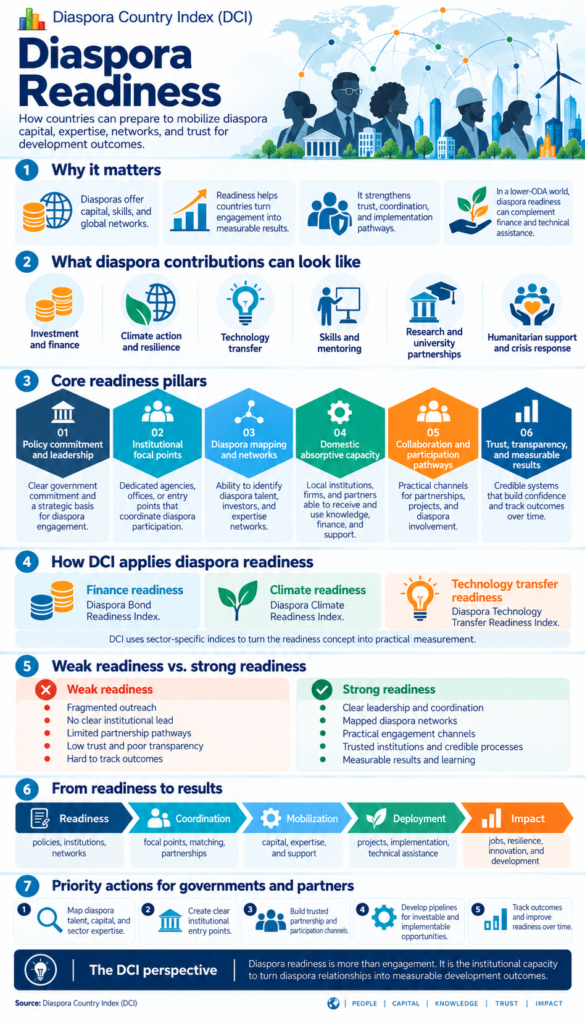
View or download the Diaspora Readiness infographic.
What Is Diaspora Readiness?
Diaspora readiness is the institutional capacity of a country to mobilize diaspora capital, expertise, technology, professional networks, and partnerships toward measurable development outcomes.
The concept moves beyond asking whether governments engage their diasporas.
It asks whether countries have built the conditions required for engagement to produce results.
From Diaspora Engagement to Diaspora Readiness
Diaspora engagement often begins with outreach, conferences, networking, consultations, and communication.
These activities matter, but engagement alone does not demonstrate readiness.
Diaspora readiness focuses on the underlying infrastructure.
Are the right institutions in place?
Are participation pathways clear?
Is diaspora expertise identified and mapped?
Do domestic institutions have the capacity to absorb knowledge and investment?
Are projects credible and appropriately structured?
Are trust, transparency, and accountability mechanisms present?
Are outcomes measured?
These questions move diaspora policy from activity toward results.
The DCI Readiness Approach
DCI approaches diaspora readiness through a progression:
Measure → Diagnose → Prioritize → Mobilize → Implement → Track
Measurement establishes a baseline.
Diagnosis identifies institutional gaps and bottlenecks.
Prioritization focuses attention on the most important interventions.
Mobilization connects governments with diaspora expertise, capital, networks, and partners.
Implementation translates readiness into practical programs and projects.
Tracking measures whether conditions and outcomes improve over time.
Three Dimensions of Diaspora Readiness
DCI currently measures diaspora readiness across three areas.
Diaspora Bond Readiness
The Diaspora Bond Readiness Index examines conditions associated with diaspora financing, including diaspora engagement policy, sovereign credit conditions, and remittance dependence.
The index helps stakeholders understand whether foundational conditions for diaspora financing are present and where additional preparation is needed.
Explore the Diaspora Bond Readiness Index
Diaspora Climate Readiness
The Diaspora Climate Readiness Index examines the policies, institutions, expertise networks, university partnerships, and initiatives supporting diaspora participation in climate action.
The framework helps identify where stronger institutional pathways could connect diaspora expertise and resources with climate adaptation, resilience, research, and investment.
Explore the Diaspora Climate Readiness Index
.
Diaspora Technology Transfer Readiness
The Diaspora Technology Transfer Readiness Index examines whether countries have the institutional conditions needed to translate diaspora expertise into sustained local capability.
Areas include national ownership, diaspora technical talent, domestic absorptive capacity, collaboration pathways, finance and commercialization, and verified delivery and retention.
Explore the Diaspora Technology Transfer Readiness Index
.
Why Diaspora Readiness Matters
The international development financing environment is changing.
Traditional ODA faces growing constraints. Governments face greater pressure to mobilize domestic resources, attract private investment, strengthen institutions, and build new development partnerships.
Diasporas represent one part of this broader resource base.
Their contribution extends beyond remittances.
Diaspora communities include investors, scientists, engineers, entrepreneurs, physicians, researchers, executives, academics, and technical specialists working across global industries and institutions.
The development question is not simply whether these resources exist.
The question is whether countries are prepared to mobilize them effectively.
Readiness as Development Infrastructure
DCI views diaspora readiness as development infrastructure.
Strong readiness helps create credible pathways for diaspora participation in:
Capital and investment
Climate action
Technology transfer
Research and innovation
Skills and knowledge exchange
Entrepreneurship
Trade
Humanitarian response
Economic development
Weak readiness often leaves these resources fragmented, informal, or disconnected from national development systems.
Building readiness means strengthening the institutions that connect global diaspora capacity with domestic opportunity.
Who Uses Diaspora Readiness Data?
DCI’s readiness data and frameworks are designed to support governments, bilateral donors, multilateral institutions, philanthropies, development finance institutions, universities, researchers, civil society organizations, investors, and diaspora networks.
Governments use readiness data to identify institutional gaps.
Development partners use it to identify technical-assistance needs.
Funders use it to identify opportunities for strengthening enabling institutions.
Researchers use it to compare countries and track change.
Diaspora organizations use it to understand pathways for participation.
Investors gain additional information about the enabling environment.
From Measurement to Action
DCI’s indices provide the measurement layer.
The next stage is translating readiness data into practical country action.
DCI is developing diagnostics, frameworks, case studies, and practical resources designed to help governments and development partners:
Identify readiness gaps
Prioritize interventions
Strengthen institutions
Build participation pathways
Mobilize partners and resources
Track progress over time
The objective is not engagement for its own sake.
The objective is stronger institutions and measurable development outcomes.
Diaspora Readiness in a Lower-ODA Era
Diaspora resources will not replace traditional development assistance.
They do represent an additional source of capital, expertise, technology, networks, and institutional knowledge.
As development finance becomes more constrained, countries need stronger and more diversified development capabilities.
Effective diaspora mobilization requires preparation.
Diaspora readiness provides a framework for understanding and strengthening that preparation.
The DCI Perspective
Diaspora engagement asks whether countries are connecting with their diasporas.
Diaspora readiness asks whether countries are prepared to turn those relationships into results.
DCI measures the institutional conditions that support this transition.
Explore DCI’s Diaspora Readiness Work
Diaspora Climate Readiness Index