

Armenia: How the Diaspora are Contributing to Engineering and Technology
Armenia offers a strong example of diaspora-enabled technology development. An estimated 7 million Armenians live across more than 100 countries. This global community connects local engineers, researchers, founders and public agencies with international expertise, investment, markets and institutions.
Armenia built its technology sector on longstanding strengths in mathematics, physics, computing, electronics and engineering. Public agencies, universities, companies and diaspora organizations now seek to convert these strengths into commercial products, higher-value exports and stronger industrial capability.
Why Armenia matters
Armenia is a small, landlocked country with a technology sector oriented toward international markets. In its 2023 activity report, Armenia’s Ministry of High-Tech Industry reported a doubling in the number of information technology companies compared with 2022. Employment increased by 30 percent. The Ministry also reported 92 percent of products from sector companies were exported during the first ten months of 2023.
These figures point to a strong export culture. Yet software exports and outsourced engineering services do not automatically create industrial depth. Armenia’s next development step involves greater local value creation through research, product ownership, prototyping, quality testing, component production and manufacturing.
The diaspora as technology-transfer infrastructure
Armenia’s diaspora contribution extends beyond remittances and philanthropy. Diaspora engineers, scientists, founders and investors introduce technical knowledge, management practices, international standards, customers and investment networks.
An Enterprise Incubator Foundation industry report identifies the diaspora as an important contributor to Armenia’s early software sector and the establishment of foreign technology companies.
Government programs have created structured entry points for diaspora participation. Neruzh invites diaspora technology founders to develop businesses in Armenia. The program provides mentoring, strategic support, investor access and grants. The 2025 edition offered grants of up to AMD 30 million for growth-stage winners.
The iGorts program places diaspora professionals inside Armenian public institutions. Between 2022 and 2023, 50 diaspora specialists worked across 23 government bodies. These programs convert broad diaspora engagement into defined assignments, new companies and retained institutional knowledge.
Building local absorptive capacity
Technology transfer succeeds when local institutions possess the skills, equipment and management systems needed to absorb outside knowledge.
Engineering City in Yerevan provides one of Armenia’s clearest examples. The public-private initiative brings together the Armenian government, the Ministry of High-Tech Industry, the Enterprise Incubator Foundation, the World Bank and private companies.
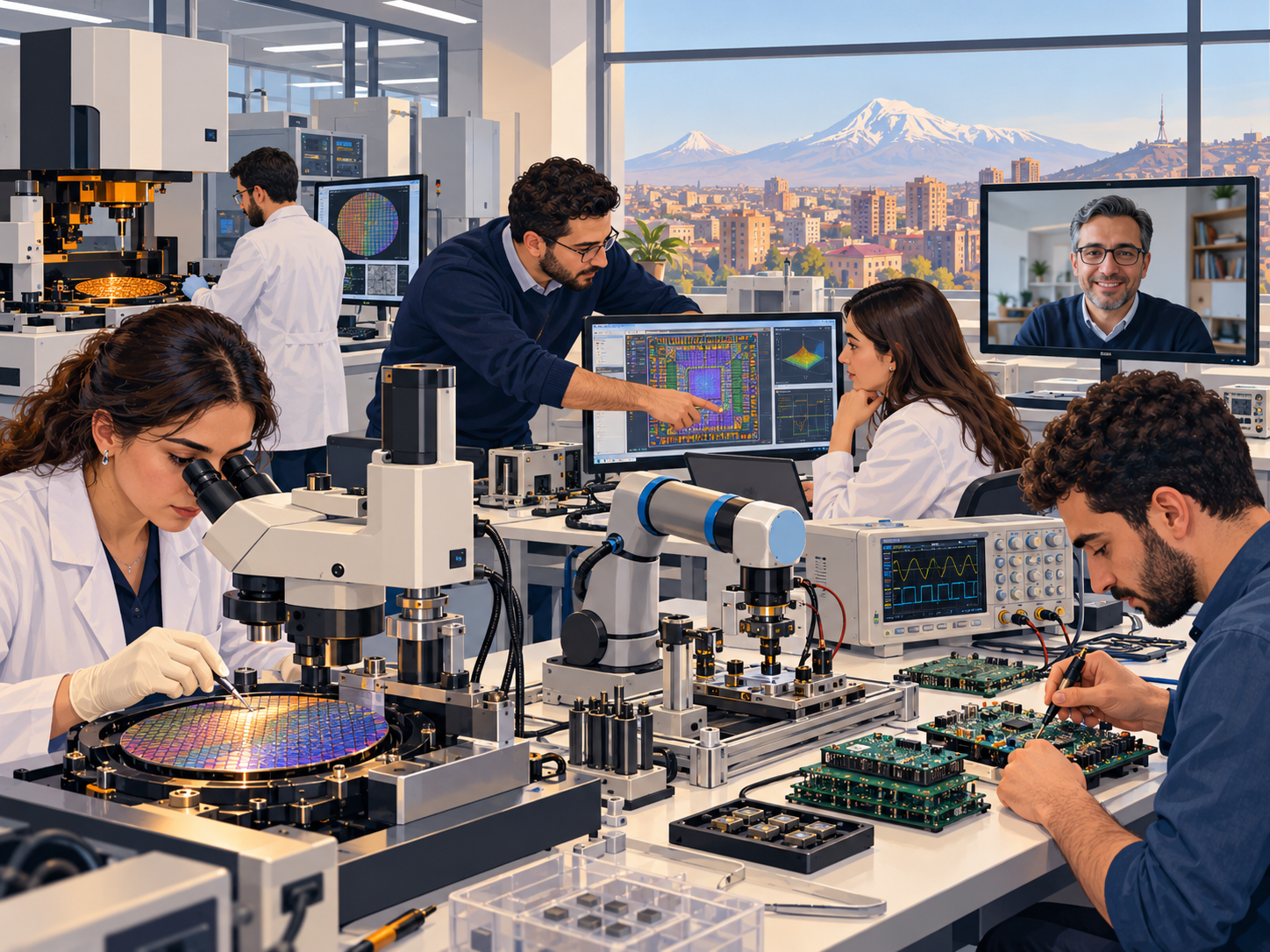
Engineering City provides shared laboratories, prototyping equipment, machine tools, production resources, accelerator services and workspaces. Focus areas include microelectronics, microchip development, 5G communications, industrial internet systems, automotive technology and biomedical engineering.
Shared facilities reduce equipment costs for smaller companies. Firms gain access to research, prototyping, testing and production resources beyond the financial reach of many individual startups. The cluster also brings companies, researchers, students and training providers into one location.
Moving from research to manufacturing
Technology transfer creates greater economic value when local firms master the full path from design through production.
Advanced Technology Group provides one example. Armenia’s High-Tech Ministry reported in 2024 that the company conducts electronic and high-frequency component design, mechanical and electromechanical manufacturing, assembly and final testing inside Armenia.
This complete production chain retains knowledge across engineering design, supplier management, quality assurance and manufacturing. Such capabilities support skilled employment and improve export readiness.
The World Bank identifies several areas where Armenia’s existing strengths support movement into higher-value activities. Opportunities include artificial intelligence research, semiconductor design, digital health, biotechnology, clean technology and seismic engineering.
Commercialization and export readiness
Armenia’s global orientation helps technology companies reach customers beyond a limited domestic market. Diaspora professionals support market entry through customer introductions, technical partnerships, investment relationships and knowledge of foreign regulatory requirements.
The next priority is increasing the share of value retained inside Armenia. This means moving from contract services toward Armenian-owned intellectual property, products, components and production systems.
Export readiness also requires:
Reliable quality and testing systems
Protection and management of intellectual property
Access to growth finance
International certifications
Stronger university-industry collaboration
Experienced product and operations managers
Local suppliers able to meet technical standards
Remaining readiness gaps
Armenia still faces gaps between public research and commercial demand. Small firms also face limited access to affordable growth finance. The World Bank has identified reliance on internal funds and retained earnings as a constraint on expansion.
UNECE’s 2023 innovation review also highlighted the need for stronger innovation governance, science-business connections, diaspora engagement systems and innovation infrastructure.
Progress requires more scale-up finance, clearer commercialization pathways and stronger measurement of results. National programs should track products launched, technologies licensed, exports generated, manufacturing capacity created and technical skills retained by local partners.
Lessons for diaspora technology transfer
Create defined participation routes. Programs such as Neruzh and iGorts give diaspora professionals clear ways to contribute.
Connect expertise with local demand. Diaspora engagement works best when firms, universities and public agencies define specific technical problems.
Invest in shared infrastructure. Laboratories, testing equipment and prototyping facilities help smaller firms absorb and apply advanced knowledge.
Link research with production. Commercialization support should connect researchers with firms, customers, finance and manufacturing partners.
Measure retained capability. Success should include local skills, intellectual property, supplier capacity, production and exports.
Build beyond the capital. Regional technology centers and university partnerships help spread engineering opportunities across the country.
What Armenia demonstrates
Armenia shows how a country with a small domestic market and a large professional diaspora may build internationally connected engineering and technology capabilities.
The strongest feature of the Armenian model is the combination of global networks with local institutions. Diaspora expertise reaches Armenia through startup programs, professional placements, investment networks, research partnerships and company operations. Shared laboratories and engineering clusters give local teams places to apply transferred knowledge.
The central challenge is converting more research and software capability into commercial products, industrial production and export-ready firms. Progress in this area would deepen Armenia’s local value creation and strengthen its position in global technology markets.
Explore the Diaspora Technology Transfer Readiness Index
DTRI assesses whether countries have the strategies, talent networks, domestic capacity, collaboration pathways, commercialization support and delivery evidence needed for diaspora-enabled technology transfer.
https://diasporacountryindex.org/diaspora-technology-transfer-readiness-index-dtri/
Sources and Further Reading
Office of the High Commissioner for Diaspora Affairs. Armenian Diaspora Communities.
Enterprise Incubator Foundation. Armenian Information Technology Industry Report, 2009.
Office of the Prime Minister of Armenia. Review of the Ministry of High-Tech Industry’s 2023 Activities, 2023.
Ministry of High-Tech Industry. Neruzh 6.0 Diaspora Technology Startup Program, 2025.
Office of the High Commissioner for Diaspora Affairs. Review of 2023 Activities, Including the iGorts Program, published 2024.
Enterprise Incubator Foundation. Engineering City.
Ministry of High-Tech Industry. Visit to Advanced Technology Group: Engineering and Manufacturing Capabilities, 2024.
World Bank. Realizing Armenia’s High-Tech Potential.
United Nations Economic Commission for Europe. Innovation for Sustainable Development Review of Armenia, 2023.