

Connecting Diaspora Expertise with Domestic Semiconductor Capability
The Semiconductor Diaspora Readiness Index (SDRI) is an initiative of the Diaspora Country Index (DCI). SDRI assesses whether countries have the institutions, networks and participation pathways needed to connect diaspora semiconductor expertise with domestic firms, universities and research institutions.
The ten-country Global South pilot examines readiness to engage overseas engineers, researchers, entrepreneurs and industry professionals in semiconductor development. Particular attention goes to assembly, testing and packaging, alongside chip design, workforce development and supplier capabilities.
Why semiconductor readiness matters
Semiconductors support computing, communications, energy systems, vehicles, medical equipment and industrial automation. Participation in semiconductor supply chains requires technical skills, reliable infrastructure, specialized facilities, finance and sustained relationships with industry.
Countries need to identify which activities fit their existing capabilities and development priorities. These opportunities include design services, testing, packaging, equipment support and specialized supplier development.
SDRI focuses on the systems supporting diaspora participation in this process, including how overseas expertise reaches domestic teams and strengthens local capabilities.
Why the diaspora matters
Diaspora semiconductor professionals bring experience in chip design, manufacturing processes, packaging, testing, quality management and supplier qualification. Their professional relationships provide routes to research collaboration, technical training, business partnerships and investment discussions.
Participation takes several forms: remote mentoring, visiting appointments, joint research, technical assignments, entrepreneurship and return migration.
SDRI examines whether countries have practical arrangements for connecting these contributions with defined domestic needs.
October 2026 Semiconductor Diaspora Readiness Index (SDRI)
| Rank | Country | Diaspora Expertise and Networks (0–2) | Institutions and Participation (0–2) | Workforce and Knowledge Absorption (0–2) | Technical Access and Collaboration (0–2) | Project Finance and Industry Connections(0–2) | Trust and Accountability(0–2) | Total / 12 | Readiness Tier |
|---|---|---|---|---|---|---|---|---|---|
| 1 | India | 1 | 2 | 2 | 1 | 1 | 1 | 8 | Operational |
| 1 | Philippines | 1 | 2 | 2 | 1 | 1 | 1 | 8 | Operational |
| 3 | Brazil | 1 | 1 | 2 | 1 | 1 | 1 | 7 | Operational |
| 3 | Malaysia | 1 | 1 | 2 | 1 | 1 | 1 | 7 | Operational |
| 3 | Vietnam | 1 | 1 | 2 | 1 | 1 | 1 | 7 | Operational |
| 6 | Mexico | 1 | 1 | 1 | 1 | 1 | 1 | 6 | Emerging |
| 6 | Morocco | 1 | 1 | 1 | 1 | 1 | 1 | 6 | Emerging |
| NR | Egypt | NA | 1 | 1 | NA | 1 | 1 | NA | Unranked |
| NR | South Africa | NA | 1 | 1 | 1 | 1 | 1 | NA | Unranked |
| NR | Thailand | NA | 1 | 1 | 1 | 1 | NA | NA | Unranked |
| NA: Insufficient evidence to assign a category score. NA does not mean zero. NR / Unranked: One or more categories lack sufficient evidence. No total score, readiness tier or rank is assigned. |
| SDRI assesses six equally weighted categories, each scored 0–2, for a total of 12 points. NA indicates insufficient evidence. Incomplete category scores receive no total, rank or readiness tier. All scores are provisional analyst judgments. |
What SDRI measures
SDRI uses six equally weighted categories. Each receives a score from 0 to 2, for a possible total of 12.
Diaspora Expertise and Networks
Systems for identifying and engaging diaspora professionals with relevant semiconductor skills and industry experience.
Institutions and Participation
Responsible institutions and clear pathways for diaspora professionals to contribute to domestic semiconductor priorities.
Workforce and Knowledge Absorption
Local skills, training capacity and institutional arrangements supporting the adoption and retention of technical knowledge.
Technical Access and Collaboration
Routes to relevant tools, facilities and technical partnerships supporting research, training and semiconductor development.
Project Finance and Industry Connections
Financing pathways and commercial relationships supporting collaborative projects, entrepreneurship and industry participation.
Trust and Accountability
Transparent arrangements, clear responsibilities and reporting practices supporting credible diaspora engagement.
Pilot countries
The initial pilot covers ten selected countries across Africa, Asia and Latin America.
Africa: Egypt, Morocco and South Africa.
Asia: India, Malaysia, Vietnam, Philippines and Thailand.
Latin America: Mexico and Brazil.
The cohort supports comparison across different industrial contexts. Selection does not imply a ranking of the Global South’s ten strongest semiconductor economies. Taiwan serves as a separate historical benchmark.
How to read the results
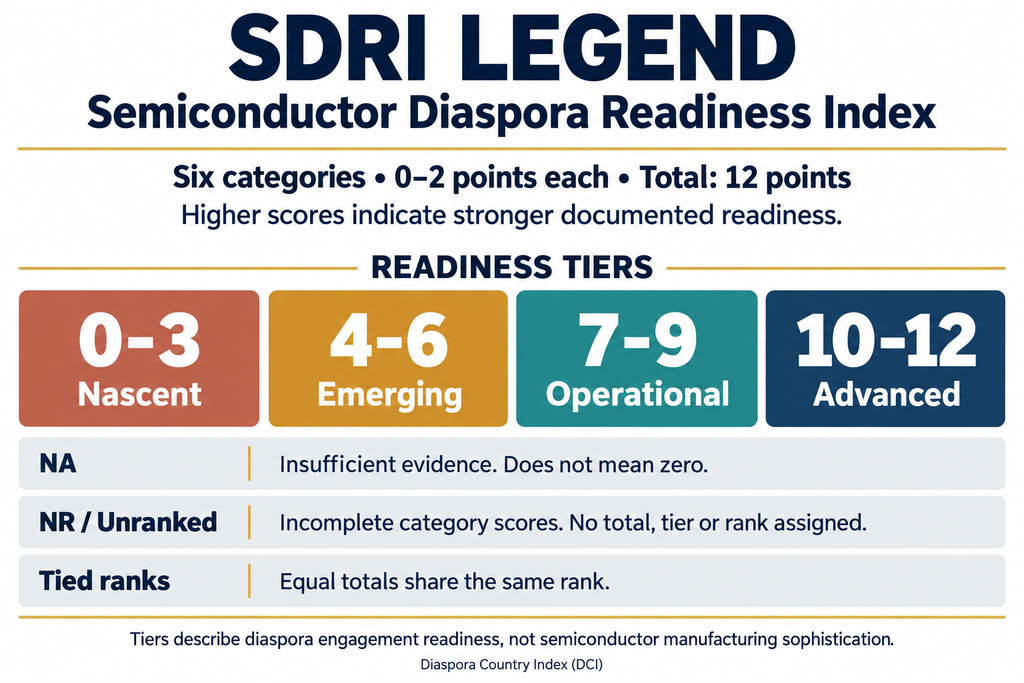
SDRI measures readiness for diaspora participation in semiconductor development. Scores do not measure chip output, manufacturing sophistication, export competitiveness or investment performance.
The readiness tiers are:
Nascent: 0–3
Emerging: 4–6
Operational: 7–9
Advanced: 10–12
These labels describe readiness within the SDRI framework. An Advanced score does not establish advanced semiconductor manufacturing capability.
NA means insufficient evidence. Only countries with scores for all six categories receive a total, tier and rank. Incomplete assessments receive NR, meaning not ranked, and an Unranked designation.
Monthly SDRI results
Each edition presents country rankings, category scores, total readiness scores and readiness tiers. Supporting materials explain the evidence, country context and scoring decisions.
Results support discussions about institutional gaps, workforce partnerships, technical collaboration and diaspora engagement priorities.
Related research
Explore the Diaspora Technology Transfer Readiness Index
Read Taiwan’s Semiconductor Transformation case study
Disclaimer
The Semiconductor Diaspora Readiness Index (SDRI) is a provisional research benchmark assessing the conditions supporting diaspora participation in semiconductor development across ten selected countries. Findings support policy discussion, research and partnership development.
Scores do not measure semiconductor production, technological sophistication, supplier qualification or investment viability. A high score does not establish advanced manufacturing capability or guarantee successful diaspora engagement.
Assessments draw on publicly available evidence and qualitative analysis. Documentation varies across countries, and evidence gaps do not establish the absence of relevant activities. Rankings remain provisional pending independent review and country validation.
Methodology Note
SDRI assesses six equally weighted categories: Diaspora Expertise and Networks; Institutions and Participation; Workforce and Knowledge Absorption; Technical Access and Collaboration; Project Finance and Industry Connections; and Trust and Accountability.
Each category receives 0–2 points under category-specific criteria, for a maximum total of 12. Scores reflect evidence available by each edition’s reporting cutoff. Equal weighting is an analytical choice.
Readiness tiers are Nascent (0–3), Emerging (4–6), Operational (7–9) and Advanced (10–12).
Insufficient evidence receives NA, distinct from a verified zero. Only countries with scores across all six categories receive a total, readiness tier and rank. Incomplete assessments receive NR and Unranked.
Countries with equal totals share a rank and appear alphabetically within each tie. Supporting sources and country notes explain scoring decisions. The ten-country pilot is a selected comparison group, rather than a comprehensive global ranking.